
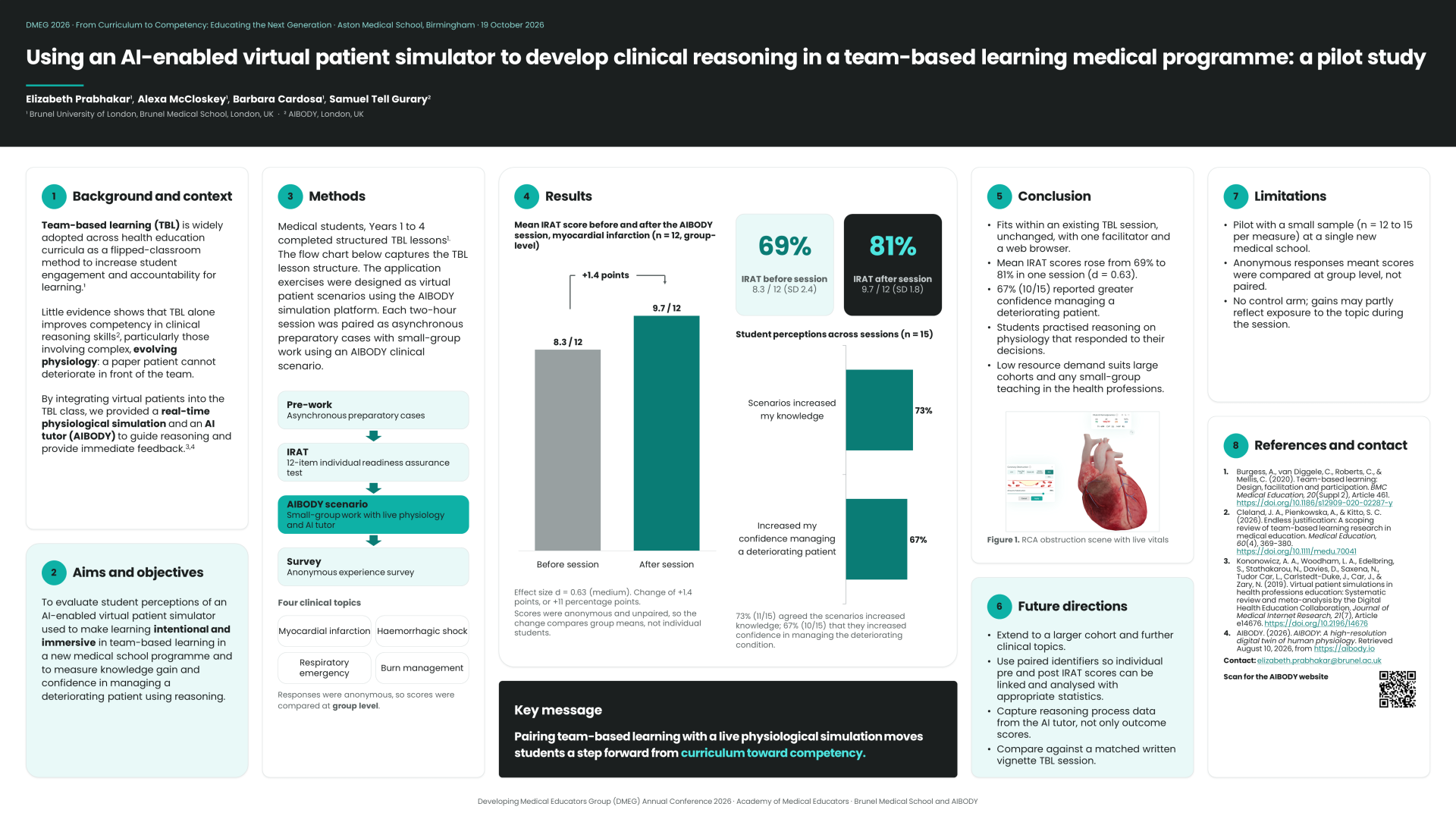
Team-based learning with live physiology lifted readiness scores from 69% to 81% in a Brunel Medical School pilot, presented at DMEG 2026
Team-based learning with live physiology lifted readiness scores from 69% to 81% in a Brunel Medical School pilot, presented at DMEG 2026
Spartanburg, South Carolina, and London, 20 October 2026. Brunel Medical School and AIBODY today present a pilot study at the Developing Medical Educators Group (DMEG) Annual Conference 2026, hosted by the Academy of Medical Educators at Aston Medical School in Birmingham. The conference theme is From Curriculum to Competency: Educating the Next Generation. The poster, Using an AI-enabled virtual patient simulator to develop clinical reasoning in a team-based learning medical programme: a pilot study, reports results from medical students at a new UK medical school.
The authors are Elizabeth Prabhakar, Alexa McCloskey, and Barbara Cardosa of Brunel Medical School, Brunel University of London, and Dr. Samuel Tell Gurary of AIBODY.
The gap the study addresses
Team-based learning (TBL) is widely adopted in health education as a flipped-classroom method. Students prepare in advance, take a readiness test, and work through a case in small groups with one facilitator. Little evidence shows that TBL alone improves competency in clinical reasoning, particularly for conditions with complex, evolving physiology (Cleland et al., 2026). A paper patient cannot deteriorate in front of the team.
What the team did
Brunel integrated AIBODY virtual patients into existing TBL sessions for Years 1 to 4 across four clinical topics: myocardial infarction, hemorrhagic shock, respiratory emergency, and burn management. Each two-hour session followed the standard TBL structure: asynchronous preparatory cases, a 12-item individual readiness assurance test (IRAT), small-group work on an AIBODY clinical scenario featuring live physiology and an AI tutor, and an anonymous experience survey. The AIBODY patient responded in real time to each team decision, and the AI tutor guided reasoning and provided immediate feedback.
What the team found
In the myocardial infarction session, mean IRAT scores rose from 8.3 of 12 (69%) before the AIBODY session to 9.7 of 12 (81%) after it, a change of 1.4 points (11 percentage points), with an effect size of d = 0.63 (n = 12, group level). Across sessions, 73% of students (11 of 15) agreed that the scenarios increased their knowledge, and 67% (10 of 15) agreed that the scenarios increased their confidence in managing a deteriorating patient.
Table 2. Pilot results reported on the DMEG 2026 poster.
| Measure | Before | After | Change |
| Mean IRAT score, myocardial infarction session (n = 12) | 8.3 / 12 (69%) | 9.7 / 12 (81%) | +1.4 points, d = 0.63 |
| Students agreeing that scenarios increased knowledge (n = 15) | 11 / 15 (73%) | ||
| Students agreeing scenarios increased confidence managing a deteriorating patient (n = 15) | 10 / 15 (67%) |
Source: Prabhakar et al. (2026). Scores were anonymous and unpaired, so the change compares group means, not individual students.
Why this matters for medical educators
The intervention fit inside an existing TBL session, unchanged, with one facilitator and a web browser. No simulation suite, manikin, or additional staff were required. Students practiced reasoning about physiology in response to their own decisions, and the low resource demand suits large cohorts and small-group teaching across the health professions.
“Every nurse and physician knows the moment a patient starts to slide, and the question is whether the team recognizes it in time. This pilot put a patient who deteriorates in front of medical students inside a format their school already uses, and readiness scores moved in one session. That is the kind of evidence educators need when they decide where simulation belongs in a curriculum.”
- Heather Tuttle, MS, RN, CEN, TCRN, Chief Nursing Officer, AIBODY.
“Brunel showed what happens when a live physiological model meets a well-structured teaching method. The students did the reasoning; the organism responded. We are grateful to Dr. Prabhakar and her colleagues for designing a rigorous pilot and for reporting its limits as carefully as its results.”
- Dr. Samuel Tell Gurary, AIBODY, co-author.

Limitations and next steps
The authors report the study as a pilot with a small sample (n = 12 to 15 per measure) at a single new medical school. Responses were anonymous, so scores were compared at the group level rather than paired by student. There was no control arm, and gains may partly reflect exposure to the topic during the session. The team plans to extend the work to a larger cohort and additional clinical topics, use paired identifiers so individual pre- and post-scores are linked, capture reasoning-process data from the AI tutor rather than outcome scores alone, and compare against a matched written-vignette TBL session.
Attend the poster
Delegates at DMEG 2026 are invited to visit the poster and speak with the authors. For the study, contact Dr. Elizabeth Prabhakar at elizabeth.prabhakar@brunel.ac.uk. For AIBODY in medical education, contact us at aibody.io.
Book a Demo | Explore Validation | Case Studies
About AIBODY
AIBODY builds a real-time, high-resolution digital twin of human physiology. Roughly 132,000 parameters are recalculated every millisecond, spanning cell chemistry to full-body homeostasis across the cardiac, pulmonary, renal, gastrointestinal, nervous, vascular, burns and trauma, and pharmacokinetic systems. Nursing and medical school faculty, simulation centers, and health systems use AIBODY so learners can practice clinical reasoning on a patient who responds like human physiology. Learn more at www.aibody.io.
About Brunel Medical School
Brunel Medical School at Brunel University of London delivers a team-based learning medical program.
References
Burgess, A., van Diggele, C., Roberts, C., & Mellis, C. (2020). Team-based learning: Design, facilitation and participation. BMC Medical Education, 20(Suppl 2), Article 461. https://doi.org/10.1186/s12909-020-02287-y
Cleland, J. A., Pienkowska, A., & Kitto, S. C. (2026). Endless justification: A scoping review of team-based learning research in medical education. Medical Education, 60(4), 369-380. https://doi.org/10.1111/medu.70041
Kononowicz, A. A., Woodham, L. A., Edelbring, S., Stathakarou, N., Davies, D., Saxena, N., Tudor Car, L., Carlstedt-Duke, J., Car, J., & Zary, N. (2019). Virtual patient simulations in health professions education: Systematic review and meta-analysis by the Digital Health Education Collaboration. Journal of Medical Internet Research, 21(7), Article e14676. https://doi.org/10.2196/14676
Prabhakar, E., McCloskey, A., Cardosa, B., & Gurary, S. T. (2026, October). Using an AI-enabled virtual patient simulator to develop clinical reasoning in a team-based learning medical programme: A pilot study [Poster presentation]. Developing Medical Educators Group Annual Conference 2026, Academy of Medical Educators, Aston Medical School, Birmingham, United Kingdom.